
Relief Valve Series | Episode 03
You do not need a muse. You need a protocol.
What this episode solves
Most micro business owners are not short on expertise.
They are short on clean starting points.
You know what you want to say. You have answered client questions, explained problems, solved urgent issues, and shared useful advice all week. Then you open a blank document and suddenly the good idea disappears behind the blinking cursor.
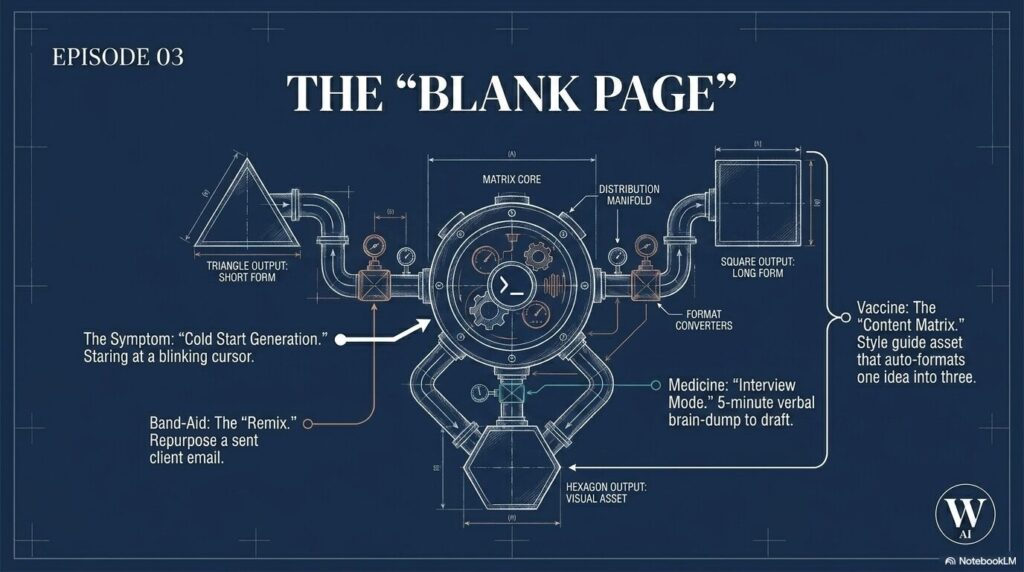
We call that cold start generation.
It is the mental tax of trying to create from nothing when your useful material is already scattered across emails, voice notes, client conversations, project updates, and half-formed thoughts.
In this episode, we open the Relief Valve on content creation. The goal is not to turn you into a full-time writer. The goal is to help you build a simple system that turns what you already know into usable content without handing your judgment, privacy, or brand voice over to a tool.
The 3 Levels of Relief
1) Bandage: The Remix
Start with something you already said.
A client email.
A project update.
A thoughtful answer you gave someone in a message.
A note you wrote after solving the same problem for the third time this month.
That is your seed.
The Remix uses AI to reformat existing expert material into a friendly draft for LinkedIn, a newsletter, a short tip, or a client-facing explanation.
The key is to separate the thinking from the formatting. You already did the thinking. AI helps reshape it.
Before using the Remix, remove names, client details, private numbers, and anything you would not say in a crowded coffee shop.
2) Medicine: Interview Mode
Sometimes there is no existing email to reuse.
Sometimes the idea is still floating around in your head while you are driving, walking, cleaning up after a client meeting, or trying to make dinner with one hand and run a business with the other.
That is where Interview Mode helps.
Instead of forcing yourself to type a perfect first sentence, talk through the idea for five minutes. Let AI ask clarifying questions, organize your ramble, and turn the raw thought into a structured draft.
You are not using AI to replace your expertise. You are using it to catch your thinking before it evaporates.
For business use, choose your tool carefully. Free or consumer-grade AI tools may not handle your information the same way as a managed business workspace. Treat voice notes, transcripts, and raw brainstorms as business data.
3) Vaccine: The Content Matrix
The Content Matrix turns one good idea into multiple useful assets.
Instead of creating one post and starting over tomorrow, you build a repeatable prompt or style guide that can turn one idea into:
- A LinkedIn post
- A short tip or caption
- A practical checklist or internal SOP
That is the shift from daily content stress to reusable content infrastructure.
The goal is not volume for volume’s sake. The goal is leverage. One thoughtful idea can become a public post, a quick educational asset, and a process document your future self can reuse.
Two Angles, One Outcome
Verónica’s Take: Protocol Before Pressure
When a system is stuck, pressure rarely fixes it.
Blank page paralysis is not always a creativity problem. Often, it is a workflow problem. The brain is trying to invent the idea, choose the format, protect the brand, manage privacy, and sound polished all at the same time.
That is too many jobs for one blinking cursor.
A better system breaks the work into smaller steps:
Capture the idea.
Sanitize the input.
Structure the draft.
Review the output.
Decide what is ready to publish.
Protocol turns internal chaos into external control.
Jason’s Take: Time, Reuse, and Operational Leverage
If you spend 20 minutes staring at a blank page before writing one usable sentence, that is not just writer’s block.
That is a business cost.
The Content Matrix helps owners stop treating every post, caption, and client tip as a custom build. Once the structure works, reuse it. Improve it. Turn it into a repeatable asset.
A good content system should not create more work. It should help you do the work once and get more useful output from it.
Safety Before Speed
AI can help you move faster, but speed is not the same thing as control.
Before using AI to draft, remix, or structure business content:
- remove client names, private details, financial data, and confidential examples
- use general descriptions instead of exact identifiers
- avoid pasting raw client conversations into free tools
- review every claim before publishing
- verify facts, numbers, testimonials, and legal or financial statements
- keep a human in the loop for anything customer-facing
A practical rule: if you would not say it out loud in a crowded coffee shop, do not put it in the prompt.
Transparency matters. So does accuracy. AI can support your content workflow, but your business is still responsible for what goes out under your name.
Try this today
The next time you are stuck staring at a blank page:
- Open a recent email where you explained something useful to a client or colleague.
- Remove names, numbers, private details, and identifying information.
- Ask AI to turn the cleaned-up version into a short educational post.
- Review the output for accuracy, tone, and promises you do not want to make.
- Save the final structure as a reusable content prompt.
One useful explanation can become one public post, one short tip, and one checklist.
That is the difference between creating from scratch and building a system.
Episode Resources
- Listen on Spotify
- Watch on YouTube
- Download: Content Matrix Starter Prompt
- Read next: Episode 04, “Digital Junk Drawer”
- Visit the Relief Valve Series Hub
[shared_files_simple hide_search=1 tags__and=”EP03,relief_valve”]
[shared_files_simple ask_for_contact_info=1 hide_search=1 tags__and=”EP03,relief_valve” file_id=474]
Closing Thought
The blank page is not proof that you have nothing to say.
It is usually proof that your ideas need a better path out of your head.
AI can reduce the friction of starting, but the value still comes from your judgment, experience, and understanding of the people you serve. That is how content becomes less of a performance and more of a system.
End Transmission.