
Relief Valve Series | Episode 06
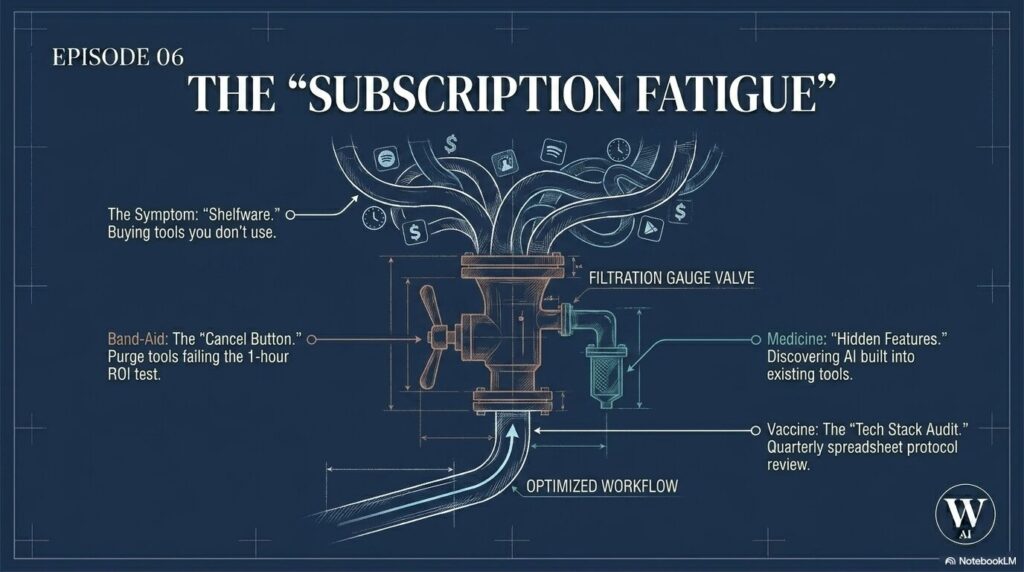
If it doesn’t save you an hour a week, it is costing you double.
What this episode solves
Most micro-business owners are not short on tools. They are short on utility.
You sign up for a new AI writing assistant because it promises speed. Then an AI image generation tool because you need a visual asset. Then a transcription tool, a PDF editor, and a spreadsheet helper. Individually, they are cheap. “Only $15 a month.” “Just $29 a month.”
We call that software bloat.
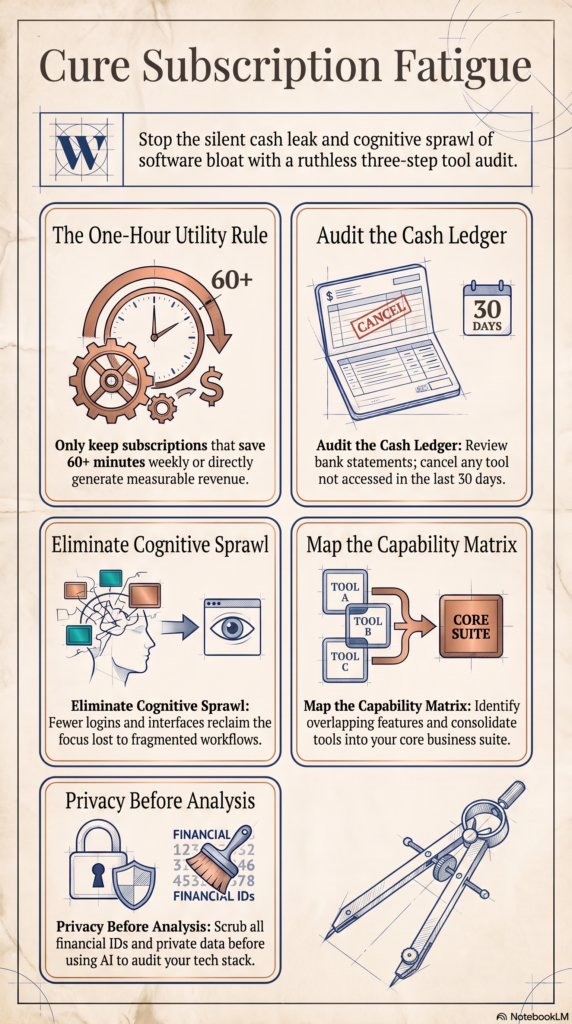
It is the silent cash leak that drains micro-business margins, but the financial cost is only half the problem. The bigger drain is cognitive sprawl—the friction of managing ten different logins, navigating ten different interfaces, and trying to remember which tool does what when your brain is tired.
In this episode, we put your tech stack on the scale. The goal is not to turn you into a tech minimalist. The goal is to measure the actual value you are getting, consolidate your capabilities, and stop paying a daily tax to tools you barely use.
The 3 Levels of Relief
1) Bandage: The Credit Card Audit
Stop the bleeding immediately. Pull your credit card and bank statements from the last 30 days. Highlight every recurring software charge. Do not rely on memory or your email inbox—go straight to the cash ledger. If you have not logged into a tool in the last month, cancel it immediately. No hesitation. You can always sign up again if you truly need it.
2) Medicine: The Capability Matrix
Once the obvious waste is cut, address the overlap. You are likely paying for multiple tools that do the exact same thing. Take your list of remaining tools and use AI to map their features. Tell a secure AI tool what you are paying for and ask it to find redundancies.
Example prompt:
“Here is a list of the software tools I currently pay for and what I use them for: [Insert List]. Review their public features and identify where their capabilities overlap. Suggest how I can consolidate these tools, particularly focusing on features that my main business suite (e.g., Google Workspace or Microsoft 365) already provides.”
3) Vaccine: The One-Hour Utility Rule
Prevent the bloat from returning. Establish a strict rule for your business: No software subscription remains active unless it saves you at least one hour per week of manual labor, or directly generates measurable revenue. Every 90 days, run a quick tool audit to put your tech stack on the scale and cancel anything that fails the utility test.
Two Angles, One Outcome
Verónica’s Take: Workflow Cleanliness and Security
Every tool you add is another interface to learn, another password to lose, and another security boundary to monitor. When your tech stack is cluttered, your workflows become fragmented. You spend more time moving data between tools than actually doing the work. Simplifying your system isn’t just about saving money; it is about reclaiming focus. A clean workflow beats a flashy feature every single time.
Jason’s Take: The True Cost of Seat Bleed
If a $20 tool sits idle, it is not just costing you $240 a year. It is costing you the billable hour you had to work just to pay for it. In a micro business, recurring expenses compound quickly against your bottom line. Consolidation is low-hanging operational fruit. By pruning overlapping tools and moving those capabilities into systems you already pay for, you immediately buy back margin without sacrificing productivity.
Safety Before Speed
Before using AI to help audit your software tools or analyze your business spending:
- Remove credit card numbers, billing addresses, account IDs, and private financial records.
- Do not paste raw billing invoices or financial details into free AI tools; use general categories and costs instead.
- Check the privacy settings of your AI workspace to ensure your tool list and business operations are not being used for model training.
- Verify which external tools are authorized to access your core client and project directories before connecting new integrations.
Colorado AI Note: For small businesses, responsible governance means knowing who has custody of your data. Keep your software integrations tight, transparent, and reviewed by a human.
Try this today
- Open your credit card portal and list every recurring software charge from the last month.
- Beside each tool, write down its monthly cost and the exact job it does for your business.
- Identify overlapping tools—are you paying for two transcription apps, three writing helpers, or two design platforms?
- Cancel any subscription that has not saved you at least one hour in the last week.
- Set a calendar reminder 90 days from now to put your tech stack on the scale again.
Episode Resources
- Listen on Spotify
- Watch on YouTube
- Download: wAI Tech Stack Audit & Capability Matrix Template
- Read next: Episode 01, The “Cool Down” Tax
- Visit the Relief Valve Series Hub
Closing Thought
The value of a tool is not what its marketing promises. It is what your business actually uses. AI should simplify your operations, not complicate your bank statement. Clean out the bloat, consolidate your systems, and keep your focus on the work that matters.
End Transmission.