
Relief Valve Series | Episode 05
You do not need to fear AI.
You need clear boundaries before business data gets anywhere near the prompt box.
What this episode solves
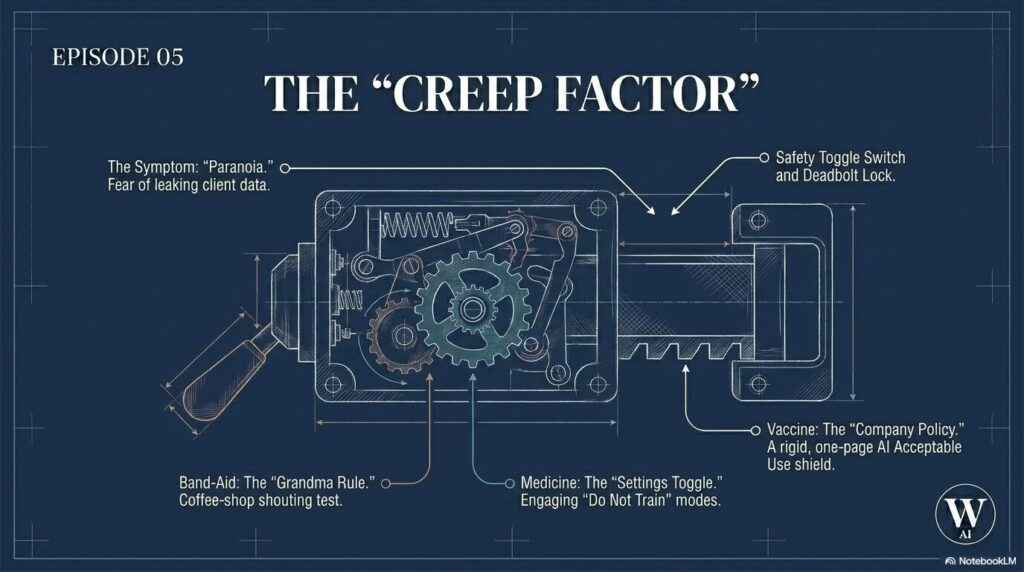
The Creep Factor is the uneasy feeling that AI is getting too close to sensitive business information.
Client details.
Financial notes.
Contract language.
Employee information.
Private strategy.
Customer data.
For micro business owners, this fear is reasonable. You are often the owner, operator, admin, sales team, service team, and risk manager all at once.
You do not have a legal department sitting down the hall.
You may not have an IT team.
You may not even have a real “down the hall.”
So when an AI tool promises to save time, but does not clearly explain what happens to your information, the safest instinct can feel like avoidance.
The problem is that avoidance has a cost.
- You keep doing manual work.
- You keep losing hours.
- You keep delaying useful automation.
- You keep carrying the mental tax of uncertainty.
This episode is about moving from fear to structure. Not reckless adoption. Not blind trust. Structure.
The 3 Levels of Relief
1) Bandage: The Grandma Rule
Before you paste business information into an AI tool, pause.
- Would you say that information out loud in a crowded coffee shop?
- Would you be comfortable with Grandma seeing it in a data breach?
If the answer is no, it does not belong in the prompt as written.
The full episode walks through how to scrub sensitive details without losing the business problem you need AI to help solve.
2) Medicine: The Settings Toggle
AI tools are not all configured the same way.
Free tiers, paid tiers, team plans, browser extensions, document tools, and embedded AI features may handle data differently.
That means settings matter.
In the episode, we talk about why micro business owners should check privacy, training, retention, and model improvement settings before using AI with real business work.
This is not about becoming paranoid.
It is about knowing which door is open before you walk through it.
3) Vaccine: The AI Acceptable Use Policy
A personal habit helps one person.
A written policy helps the business.
The longer-term fix is a simple AI Acceptable Use Policy, also called an AI AUP.
Not a 50-page legal manual.
A usable one-page starting point.
The goal is to define what AI can touch, what it cannot touch, which tools are approved, and where human review is required.
That is how “just be careful” becomes an actual business practice.
Two Angles, One Outcome
Verónica’s Take: Boundaries Before Automation
If you do not know what should go into a system, you are not ready to automate the system.
You are only speeding up uncertainty.
For micro businesses, responsible AI does not require enterprise theater. It requires clear boundaries, repeatable steps, and human judgment where it matters.
Safe does not have to mean slow.
It means the next step is controlled.
Jason’s Take: Trust Is an Operating Cost
Avoiding AI has a cost.
Using AI carelessly also has a cost.
The better move is structured confidence.
When you know what data is allowed, what settings should be checked, and who approves the output, you reduce both the fear cost and the risk cost.
That is how a micro business starts buying back time without gambling with trust.
Safety Before Speed
AI safety is not only about preventing data leaks.
It is also about trust.
When AI touches customer communication, business decisions, marketing, hiring, finances, education, health information, or other sensitive areas, human review matters.
For Colorado businesses, this aligns with the broader direction of emerging AI expectations: be transparent, protect personal data, avoid misleading people, and do not outsource judgment entirely to an automated tool.
This episode is not legal advice.
It is a practical starting point for micro business owners who want to use AI more responsibly.
Try this today
Before you use AI for a business task, pause for 30 seconds and scan your prompt for anything that identifies a real person, business, account, client, employee, vendor, or private situation. Then ask:
Could I explain why this information belongs in this tool?
If the answer is no, rewrite the prompt with placeholders.
- Use “Client A” instead of the real client name.
- Use “a regional vendor” instead of naming the company.
- Use a general category instead of exact private financial details.
- Use the business problem instead of pasting sensitive contract language.
That one step will not solve every AI safety issue.
But it slows down the most obvious leaks.
And that is where practical AI governance begins.
Episode Resources
- Listen on Spotify
- Watch on YouTube
- Download: One-Page AI Acceptable Use Policy Starter Template
- Read next: Episode 06, “Subscription Fatigue”
- Visit the Relief Valve Series Hub
Closing Thought
Fear says, “Do not touch the tool.”
Governance says, “Set the boundary first.”
AI gets less creepy when you stop treating safety as a feeling and start treating it as a workflow. Listen to the episode. Set the boundary. Then get back to work.
End Transmission.